
In the sprawling, neon-lit arena of professional esports, where digital titans clash and legends are forged in silicon, the organization known as Dignitas had long stood as a venerable pillar. With roots stretching back nearly two decades, it had carved its name into the annals of games like League of Legends and Rocket League, amassing a legion of followers across the social media landscape. Yet, in the summer of 2022, this seasoned competitor stumbled not on the battlefield of a tournament, but on the treacherous, meme-filled plains of Twitter. A single, seemingly offhand comment—"mobile gaming is not gaming"—ignited a firestorm that would see the organization ratioed, roasted, and ultimately, retreating with a digital tail between its legs.

The tweet, a response to another user, was like tossing a spark into a powder keg. The internet, that great and chaotic beast, awoke with a collective roar. The engagement metrics told a stark story: the comments, pouring in like a tidal wave, vastly outnumbered the likes and retweets, a classic sign of a community delivering a brutal, unified rebuttal. It was a proper, old-fashioned ratio, and Dignitas was squarely in the crosshairs.
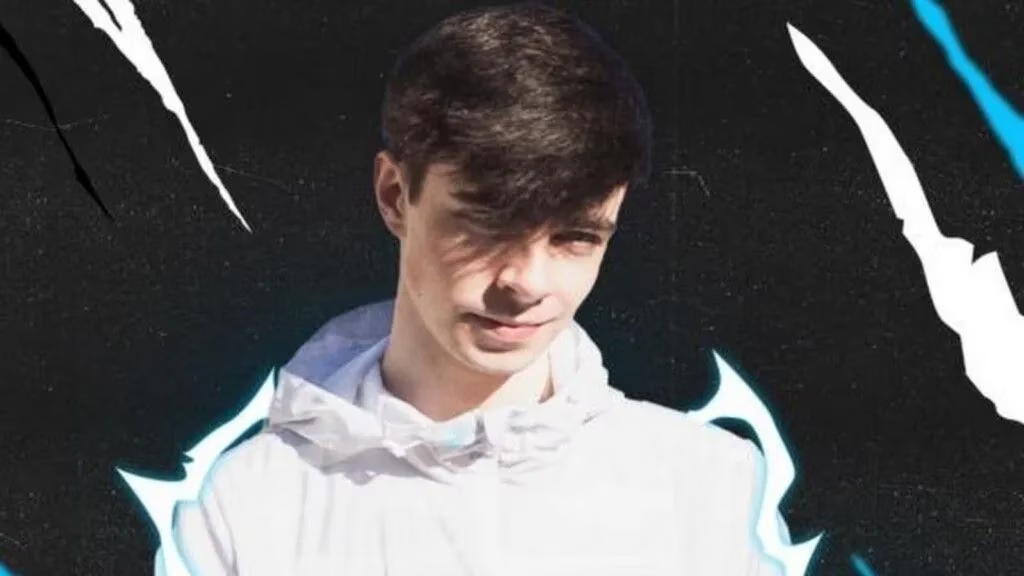
The call was answered from the mobile gaming frontiers. First came iFerg, a YouTuber and Call of Duty: Mobile champion with a resume glittering with tournament victories. His retort was a masterclass in clapback: "I have won more tournaments in the last 5 years than your entire organization combined. The most relevant thing that has happened to you this decade has been this ratio." Ouch. Talk about hitting where it hurts. Not long after, Sonho, a star of Apex Legends Mobile, chimed in with a dismissive flourish that became instant meme fodder: "I can’t remember asking + mobile gamers are real gamers + the easiest relationship of my life that I’ll remember for decades to come."
Faced with this mounting tsunami of dissent from professionals and fans alike, Dignitas did the only sensible thing—they deleted the tweet. But the story wasn't over. In a move that was either admirably self-aware or a desperate attempt at damage control, the organization followed up by posting a clown meme template, poking fun at their own initial decision to wade into such murky waters. It was a silent admission: Well, that didn't go as planned, did it? 🤡
This whole fracas, of course, was about more than just one bad tweet. It tapped into a long-simmering debate within the gaming world about legitimacy and platform hierarchy. Is gaming defined by the power of the hardware, or by the skill, passion, and community it fosters? By 2026, looking back, the controversy seems almost quaint. The mobile gaming landscape has only solidified its dominance, proving Dignitas' take was not just unpopular, but fundamentally out of step with reality.
Consider the evidence, even back then:
-
The Financial Juggernaut: Reports predicted mobile gaming revenue would smash the $200 billion mark in 2022. That's not pocket change; that's the engine of the industry.
-
The Accessibility Factor: For countless players worldwide, a smartphone is their primary, and sometimes only, gateway to interactive entertainment. Its convenience and portability are unmatched.
-
The Quality Bar: Major franchises had already embraced the platform. Fortnite brought battle royale to phones in 2018. Genshin Impact (2020) redefined mobile visual fidelity. Even Dignitas' own flagship game, League of Legends, saw Riot Games launch Wild Rift specifically for mobile audiences.
The irony of Dignitas' comment, given their involvement in LoL, wasn't lost on anyone. It was a bit like a sailor denying the existence of the ocean.
In the end, the digital mob had its fun. The comment sections became a playground for witty jabs and savage ratios. For most, it was a humorous spectacle—a giant being poked by a thousand needles. After acknowledging the misstep, Dignitas presumably returned to its core business: scrims, strategy, and chasing victory in titles like Valorant. The incident serves as a timeless lesson for esports entities navigating the public square: in an era where the lines between platforms are blurring, gatekeeping is a risky game. The real play isn't in defining what "real gaming" is, but in recognizing and respecting the vast, vibrant ecosystem where it all lives—from the high-end PC rig to the smartphone in your pocket. The pixels don't care where they're rendered; they only care about the stories they help tell and the communities they build.