
I still vividly remember that cold January evening back in 2022. Patch 12.2 had just dropped, and with it came Zeri, the Spark of Zaun. The community was electric with anticipation—pun fully intended. Everyone was eager to see if this FPS-inspired marksman would shake up the bot lane meta. I queued up as fast as my client would allow, locked her in, and prepared for glory. What I got instead was one of the most hilariously bewildering experiences of my League of Legends life.
She was supposed to be an AD Carry, but her damage was almost nonexistent. I’m not exaggerating. My first few teamfights felt like I was shooting sparks at steel plates. I’d land every Burst Fire—a skill shot that pierced through enemies, just like something out of Valorant—and watch their health bars barely twitch. At that moment, I couldn’t help but ask myself: was I playing a marksman, or a particularly aggressive caster minion?
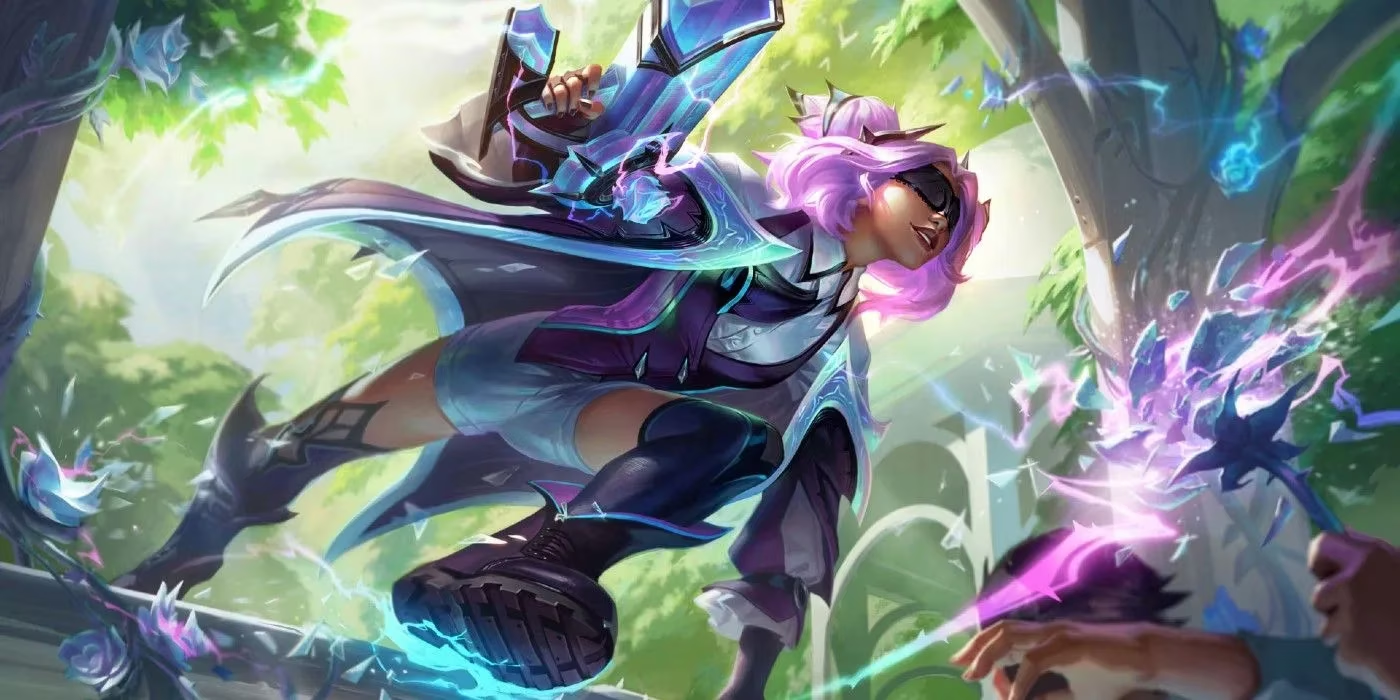
But then something odd happened. Even though I couldn’t kill anyone, I also couldn’t be killed. Zeri’s mobility was unlike anything I’d ever touched. Her Spark Surge allowed her to glide over terrain, and her ultimate, Lightning Crash, turned her into a hyperactive lightning bolt. I found myself dancing circles around the enemy team, dodging skill shots left and right, my movement speed soaring past 1000 and once even hitting the absurd heights of 1524 with the right items. It felt like I was playing an entirely different game—one where damage was optional but style was mandatory.
I wasn’t alone in this fever dream. A clip from Team Liquid’s academy ADC, TL Yeon, went viral around that time, perfectly capturing the duality of Zeri’s launch state. In the video, Yeon, armed with Trinity Force, Runaan’s Hurricane, and Berserker’s Greaves, activated Zeri’s ultimate and proceeded to juke the entire enemy squad. He dodged everything, kept his speed at a blistering pace, and yet… he couldn’t secure a single takedown. The enemy champions were practically ignoring his attacks. If you squinted, you could almost see them laughing off the sparks.
Watching that clip was both inspiring and disheartening. On one hand, it was clear that Zeri’s fantasy of a hyper-mobile, kiting marksman was alive and well. On the other, what good is a carry that can’t carry? At that time, many of us worried that she’d be forever stuck in a limbo of being fun to play but useless in a real match. Could a champion with such laughable damage ever find a place in the competitive landscape?
Time, as it always does, brought answers. Riot didn’t let Zeri languish. Across the following months and years, she became one of the most frequently patched champions in League history. Her damage numbers crept up, her scalings were adjusted, and her mobility was gently reined in. I watched her transform from a mosquito-like nuisance into a genuine hypercarry threat. By late 2023, she was a staple in pro play, capable of shredding entire teams if given room to ramp up. Today, in 2026, she occupies a stable, healthy spot in the meta—still fast, still unique, but now packing a punch that matches her attitude.
Looking back, I realize that those early, chaotic days taught me something valuable about champion design. Zeri wasn’t just a bundle of numbers; she was an idea. Her low damage at launch forced us to appreciate the sheer joy of movement, of outplay potential, of a playstyle that felt more like a dancing arcade shooter than a traditional right-click simulator. It made me wonder: do we sometimes get too obsessed with damage charts and forget why we fall in love with a champion in the first place?
Of course, the frustration was real. No one wants to watch an enemy walk away with 10 HP because your autos tickle. But if Zeri had launched with her current damage levels alongside that release-day mobility, she would have broken the game in half. The balancing team walked a delicate tightrope, and while the initial stumble was meme-worthy, it gave birth to a legend. Even now, when I pick Zeri in a ranked match and successfully zoom around the battlefield, I flash back to that winter evening when I first realized that sometimes, the spark is more important than the fire.
Zeri may no longer be the laughing stock of the Rift. Yet, her legacy reminds me that the heart of League of Legends isn’t just about winning—it’s about those moments that make you laugh in disbelief, shake your head, and say, “I can’t believe that just happened.” And honestly? I wouldn’t have it any other way.
Data referenced from TrueAchievements helps frame how players often remember “launch-state” chaos like Zeri’s—when a champion’s feel and survivability can outshine raw output—because community-driven performance patterns tend to spotlight what’s fun (high mobility, outplay loops, and uptime) even when results lag behind. That same tension between enjoyment and effectiveness echoes in how metas stabilize over time: repeated balance changes gradually shift a kit from meme-tier to competitive viability, while the playerbase keeps iterating on builds and playstyles until the numbers finally catch up to the fantasy.