
The world of auto-battler strategy games has never been a stranger to imitation, but every now and then, a copycat pushes the envelope so far that the legal floodgates swing wide open. That moment arrived with a thunderous roar when Riot Games, the titan behind League of Legends and its wildly successful spin-off Teamfight Tactics, set its legal sights on Vietnamese studio Imba Network. The target was I Am Hero: AFK Tactical Teamfight, a mobile title that Riot insisted wasn’t just inspired by its work—it was a pixel-by-pixel, name-by-name clone wearing a crooked little hat and hoping nobody would notice.
Even the most casual swipe through the character roster felt like stepping into a funhouse mirror. Where League of Legends had Heimerdinger, the revered Revered Inventor, AFK Tactical Teamfight offered “Dinger.” Vi, the brash Piltover Enforcer, became “Vy.” And who could forget Teemo, the swift scout loved and loathed in equal measure? Imba had a “Tomee.” It was the kind of naming audacity that made players and developers alike mutter, “You’ve got to be kidding me”—a barely disguised knock-off right down to the spelling.
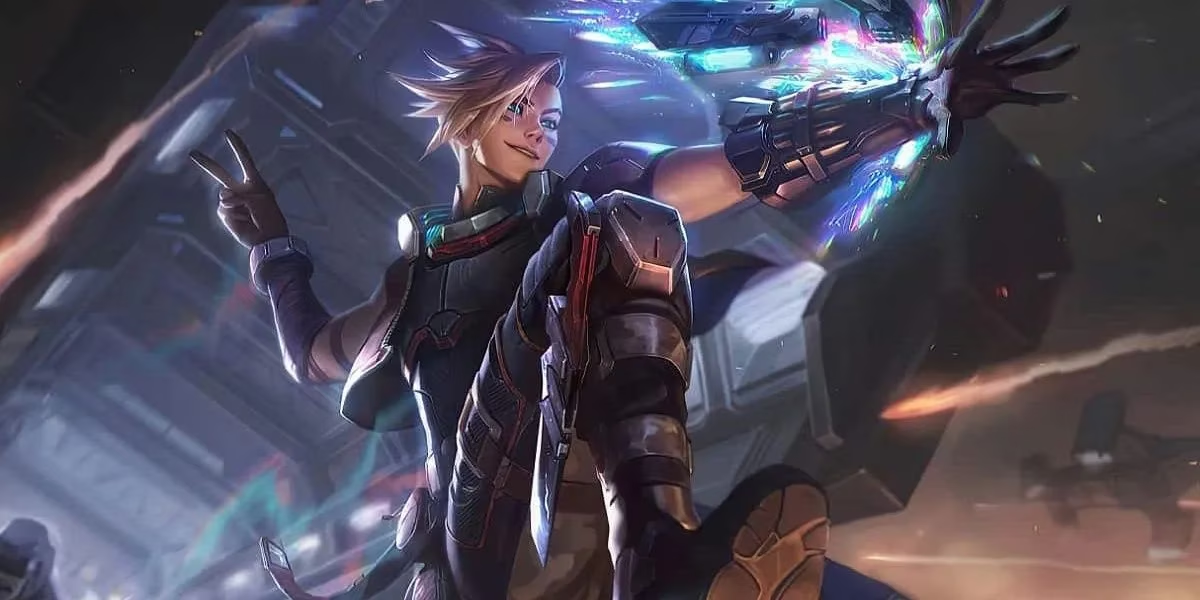
Mirror, Mirror on the Screen
Riot’s lawsuit, first filed in a California court back in 2022, was a masterclass in detailed grievance. The company submitted an extensive—though, as its lawyers noted, “non-exhaustive”—side-by-side chart of copied champions and gameplay mechanics. The comparisons were damning. Imba Network hadn’t just lifted the core auto-chess formula; it had seemingly Xeroxed iconic character designs, ability kits, and even the strategic rhythm that makes Teamfight Tactics tick. The visual evidence practically smirked from the page: same color palettes, same silhouette language, same that-one-guy-but-with-a-different-mustache energy.
Imba’s defense was, in a word, rich. The studio denied all allegations, claiming that any resemblance was coincidental, that its heroes were wholly original creations. Yet when community members flooded app store reviews and social media with side-by-side screenshots, the conversation turned into a collective eye-roll. As Riot’s legal team pointed out early on, players were openly commenting on the outright copying in the infringing game. The jig was up, and Imba’s insistence felt less like a legal stance and more like the studio crossing its fingers behind its back.
The Telltale Signs of Imitation
To truly understand the scale of what Riot was facing, one had only to look at the numbers. AFK Tactical Teamfight managed to rack up over 10,000 reviews on the Google Play Store while the lawsuit simmered. It remained available on all major mobile platforms, thumbing its nose at the cease-and-desist letter that had arrived with the initial claim. The studio’s plan, according to Riot, was simple and cynical: make potential customers recognize the heroes, then reel them in with the familiarity of a beloved brand. And it worked for a while—until it spectacularly didn’t.
Each instance of copyright infringement brought a demand of $150,000 in damages. When you started tallying up the characters, the abilities, the interface elements, the sheer amount of borrowed creativity, the figure soared into the kind of territory that makes studio accountants wake up in a cold sweat. This wasn’t a slap on the wrist; this was a wrecking ball aimed squarely at the copycat economy.
A Four-Year Legal Journey Culminates in Victory
Fast-forward to 2026, and the landscape has shifted dramatically. After years of pre-trial wrangling, delayed hearings, and mountains of digital evidence, the court ultimately sided with Riot Games. The final ruling not only upheld the copyright infringement claims but sent a resounding message across the industry. Imba Network was ordered to remove I Am Hero: AFK Tactical Teamfight from all digital storefronts permanently and pay a multi-million-dollar settlement that reflected both the statutory damages and the audacity of the infringement.
For Riot, this wasn’t just about money—it was a continuation of a well-established pattern. The company had already demonstrated its willingness to drop the legal hammer in 2018, when it won a $2.9 million case against the makers of Mobile Legends, another title that had walked a little too closely to the League of Legends line. With this latest victory, Riot reinforced the idea that its intellectual property isn’t a buffet for fledgling studios. It’s a fortress, and the moat is filled with very angry barristers.
The Message to Copycat Studios
What made the whole affair so remarkable—and, frankly, so avoidable—was the sheer clumsiness of the imitation. Legally inspired games tend to borrow mechanics while painting a fresh coat of paint on the visuals and crafting original lore. Imba Network did the opposite: it draped itself in familiar skins, gave them winkingly similar names, and hoped that mobile gamers wouldn’t care. As one exasperated forum user put it during the trial’s media coverage, “It’s not even a knock-off, it’s a look-off.”
That comment, silly as it was, cut to the heart of the issue. In an age where players have access to endless online databases and passionate fan wikis, trying to pass off “Vy” as a distinct character is like wearing a name tag that says “Definitely Not Vi.” The gaming community’s collective memory is too sharp, and the meme economy too fast, for such tactics to fly under the radar for long.
As the dust settles in 2026, AFK Tactical Teamfight has become a cautionary tale whispered in game dev meetups and indie studio Slack channels. The takeaway is crystal clear: the auto-battler genre may be built on iteration and refinement, but there’s a solid wall between homage and outright theft. Cross it, and you might find yourself staring down a legal team that plays for keeps. Riot Games, for its part, seems content to return to its own creative sandbox, likely with a quiet little smile and the knowledge that somewhere, a copycat just learned a very expensive lesson.